
MAPP QUESTIONNAIRE-INTERVIEW
AUTOMATIC PROFILE

We Are Biological Machines
Programmed By Our Caregivers

- Between Clinical Psychology & Engineering -
Automatic Profile
The MAPP is a clinical psychological theory suitable for any related application. One of the most interesting and useful of such applications is the development of a personality profiler.
The MAPP Questionnaire-Interview (MAPP-QI) not only provides a personality profile over its 7 dimensions but also works as a powerful clinical tool. It gives the user the chance to reflect upon their current and past close relationships and provides the clinician with a complete picture that can be extremely useful to their work.
We describe the object of the tool, its features, and its automatic processing through AI.
1. What the MAPP-QI Measures
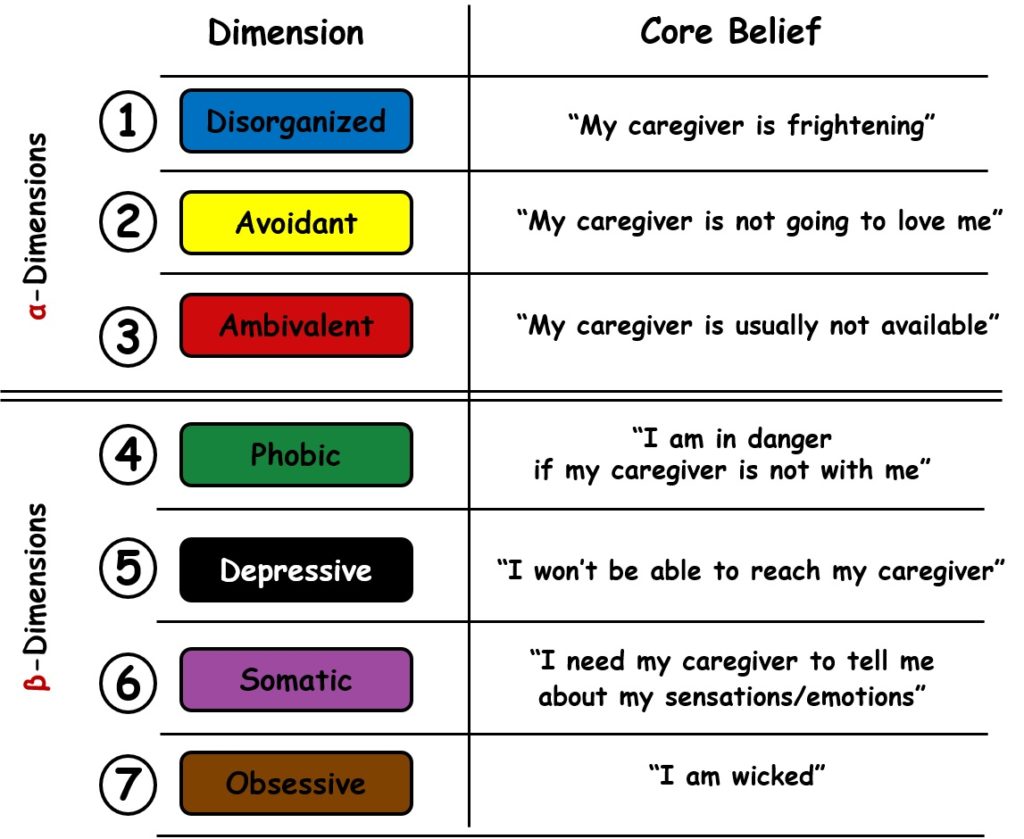
The MAPP-QI is a self-report that measures our personality and its developmental underpinnings. Personality is assessed over its 7 dimensions:
- Disorganization
- Avoidance
- Ambivalence
- Phobicity
- Depressivity
- Somaticity
- Obsessivity
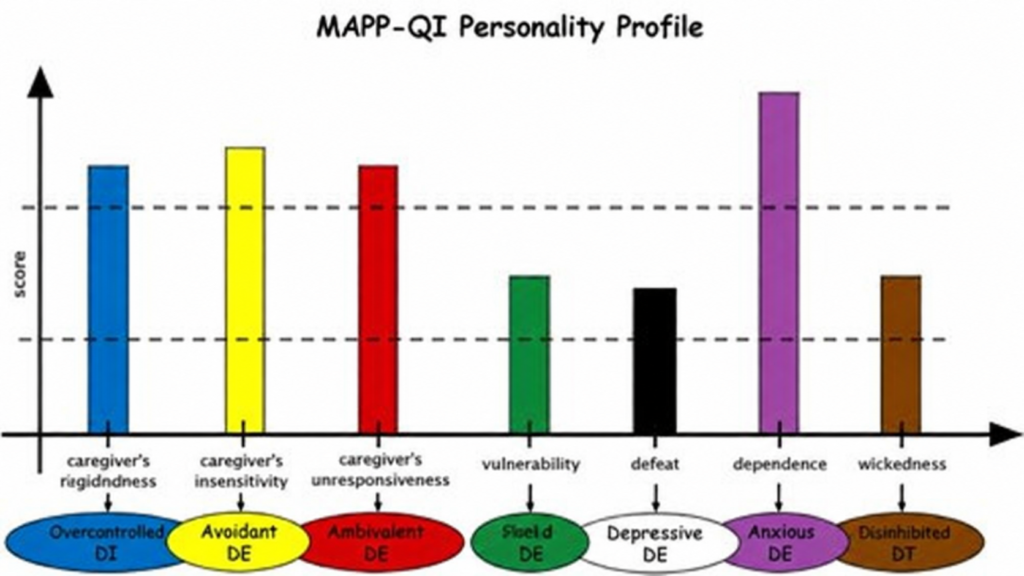
The overall assessment generates our personality profile, which can be graphically represented by a bar-diagram.
Each dimension corresponds to an implicit core belief that is imprinted in the context of our attachment relationships – a kind of data imprint (DI). These beliefs silently drive our socio-psychological perspectives.
The instrument also provides a profile of the caregiving we received in childhood from our maternal and paternal figures through the evaluation of our subjective experience.
The MAPP-QI has been implemented in Django/Python to be administered over the internet.
The completion usually requires up to 60 minutes. Items are meant to be answered readily, relying on ‘instinct’ and not reflection. They all have a closed answer – such as a multiple-choice or drop-down list.
The attachment and caregiving items (in QA, and QC) are rated on a 0-to-10 scale, where zero corresponds to non-adherence with the responder’s view and ten with full adherence.
2. Main Features of the MAPP-QI
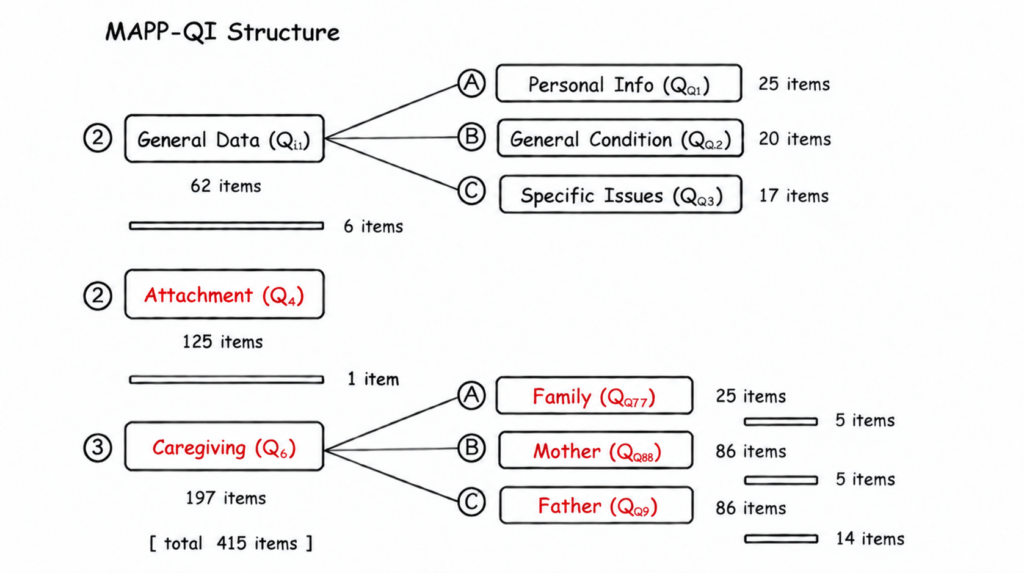
The MAPP-QI is a large questionnaire consisting of 415 items divided into 3 main sections – QD, QA, and QC.
QD is a preliminary section for the collection of data that is not directly related to the attachment and caregiving scales but useful both to integrate such scales and for general clinical purposes. It consists of 3 subsections (QDP, QDG, and QDS).
QA is dedicated to the direct assessment of the 7 personality dimensions (attachment scales). Items are focused on our thoughts and feelings about attachment-relationships and directly related matters. In particular, part of the section addresses romantic relationships.
Finally, QC is devoted to the direct assessment of the 7 caregiving features as we experienced them in childhood (caregiving scales), especially with the two principal attachment figures – mother and father (maternal and paternal figures). There are 3 subsections: QFy for the family in general, QCM for the mother, and QCF for the father.
3. AI to Read the MAPP-QI
Once the MAPP-QI is completed, it needs to be evaluated. A clinician who knows the theory can do that by analyzing the scale scores and specific answers. This operation can provide not only a personality profile but also extremely useful clinical information.
On the other hand, the human processing of a large questionnaire requires time, which varies depending on the complexity of the case. Therefore, the MAPP-QI scoring process and the generation of the corresponding profile have been automated.
Different AI models are used to analyze the responses “as a clinician would” and produce a coherent interpretation based on all the information collected. This distinctive feature of the processing system allows the MAPP-QI items to function similarly to statements provided during a clinical interview.
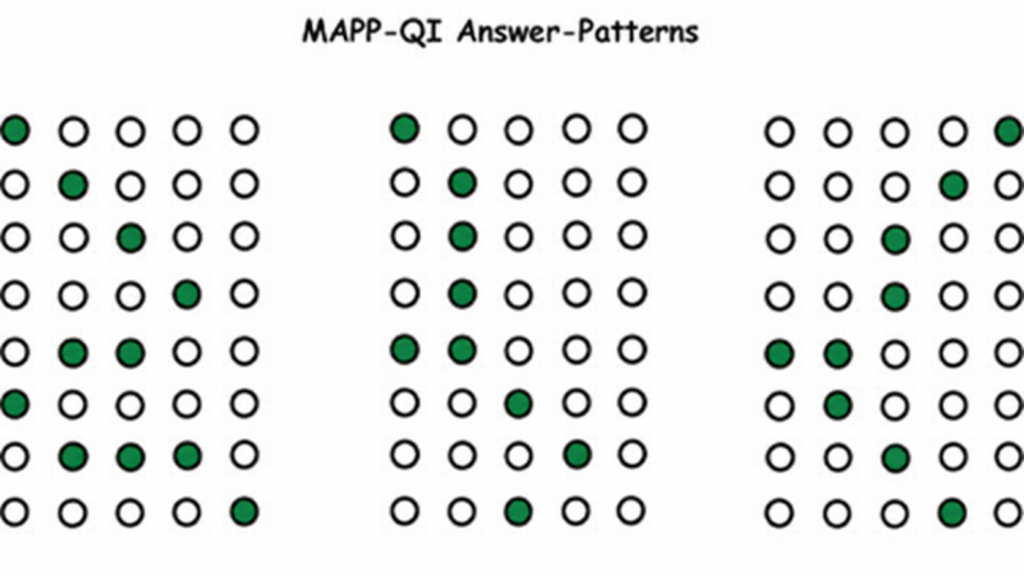
Nonetheless, the MAPP-QI automated system is designed strictly as a support tool for professional evaluation. It is intended to assist the clinician’s assessment and interpretation, not to replace clinical judgment or professional responsibility. Finally, it is also important to underline that the system does not provide a diagnosis or any treatment-related advice, let alone prescriptions.
F.A.Q.
Automatic Profile
The MAPP-QI usually takes 50-60 minutes. It consists of many items, but they should be answered ‘on the fly’, following one’s feeling.
The MAPP-QI requires us to focus on ourselves and our experiences in close relationships. It is very personal and can elicit deep emotions. In this sense, it is demanding. But normally, the awareness that we gain from completing it makes this effort negligible.
The MAPP-QI system provides a personality profile that can make us reflect on key aspects of ourselves and our close relationships. Moreover, it can offer a psychologist precious material to help us develop and reach real change. The advantage that we can take from the “interview” is proportional to our curiosity and desire for self-development.
There are many different personality tests, and it is impossible to make a general and quick comparison. However, taking as a reference the widespread Big Five model of personality and the derived tests, this “test” presents significant differences, of which the 2 major ones are the following. (1) The MAPP-QI system is based on an etiological model of personality. Therefore, the profile it generates can be connected to its causes. (2) The evaluation of the MAPP-QI goes beyond the level of language by finding relevant information across the whole questionnaire and not just in its isolated scales. These features greatly favor the MAPP-QI over the Big Five questionnaires.
The core beliefs that make up our personality are implicit knowledge imprinted in our brain. They are non-verbal and cannot be directly reached by our conscious thought. However, these beliefs have a great influence on the way we act, think, and feel – and, consequently, build other knowledge. The MAPP-QI measures the most direct of such manifestations to evaluate the strength of the underlying core beliefs.
Artificial Intelligence – and in particular a neural network – can learn how to do some of the things that a psychologist does. Although whatever a test can generate needs always to be considered just as a possible hint – and not as the opinion of an expert – this kind of assessment will be the closest possible to a first human evaluation and serve as a useful basis for further analyses and reflections.
A psychological test can only provide a hint for further assessment to be performed by a professional. Therefore, if our profile shows unusual values, the best thing to do is to contact a professional for a consultation.
 English
  Italiano